2026 Editors’ Convention: Reimagining Media Viability, Independence and Trust in the Digital Age
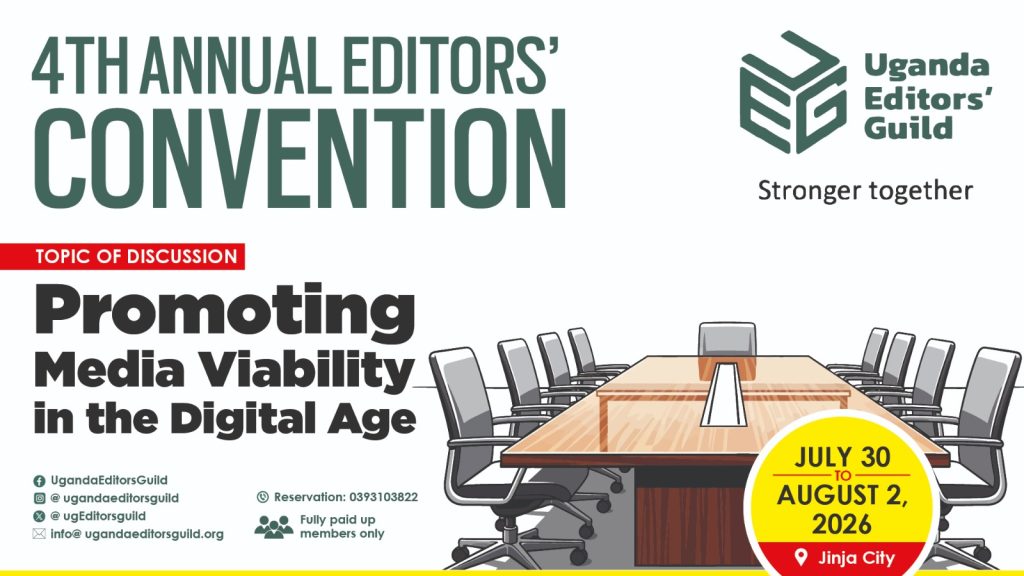
The Uganda Editors’ Guild (UEG) will convene editors, senior journalists and key media stakeholders for the 2026 annual Editors’ Convention, scheduled to take place from 30th July to 2nd August 2026 in Jinja, Uganda.
Now established as one of the most influential gatherings on Uganda’s media calendar, the Editors’ Convention continues to serve as a critical platform for reflection, dialogue, and strategic action on the future of journalism in Uganda and beyond.
A Changing Media Landscape
Since its inception in 2019, the convention has grown into a premier space where editors, academics, regulators, and media development partners engage on pressing issues affecting journalism.
The 2026 edition comes at a defining moment for the media industry. Under the theme: “Reimagining Media Viability: Innovation, Independence, and Public Trust”
The convention responds to a rapidly evolving environment shaped by digital disruption, declining traditional revenues, shifting audience behaviors, and increasing pressure on editorial independence.
According to the President of Uganda Editors’ Guild, Mr. Daniel Kalinaki, the media sector is facing profound structural change. “Traditional advertising-based business models are weakening, while digital platforms increasingly dominate news distribution often prioritizing speed and virality over accuracy and public interest. We need to adopt.”
At the same time, financial strain has affected newsroom capacity, reduced investment in quality journalism, and heightened vulnerability to political and commercial influence according to Senior editor and the Guild’s treasurer; Mr. Alex B. Atuhaire.
Why this convention matters now
The 2026 Editors’ Convention is a strategic response to urgent sector-wide challenges, including:
- Declining media sustainability and revenue models
- Growing misinformation and disinformation
- Digital platform dominance over news distribution
- Threats to editorial independence and press freedom
- Erosion of public trust in journalism
- Regulatory and political pressures on media practice
In this context, the convention seeks to reposition journalism as a public good, strengthen ethical practice, and explore innovative pathways for sustainable media viability.
Key Objectives of the Convention
The convention is designed to:
- Bring together newsroom editors
- Strengthen collaboration among media leaders and stakeholders
- Explore sustainable and innovative media business models
- Protect editorial independence in a rapidly digitizing environment
- Build stronger partnerships for media freedom and accountability
- Enhance public trust in journalism through ethical practice and engagement
Day One: Reflection on Elections and Media Practice
A key highlight on the first day will be the session on media coverage of the 2026 elections, featuring a high-level panel of experienced editors and media experts including representatives from:
- Nation Media Group (NMG)
- Uganda Radio Network (URN)
- ACME (African Centre for Media Excellence)
- Vision Group
- Uganda Law Society
This session will critically examine emerging challenges in election reporting, newsroom safety, and the evolving political communication environment.
The day concludes with a networking dinner for delegates.
Day Two: Official Opening and Strategic Dialogues
The second day features the official opening ceremony with remarks from the President of the Uganda Editors’ Guild and a keynote address by the Minister of ICT and National Guidance.
Development partners and media stakeholders including Konrad-Adenauer-Stiftung (KAS), the Uganda Media Centre, the Danish Embassy, and the British High Commission will deliver keynote interventions on media development, digital transformation, and press freedom.
Key thematic sessions include:
1. Media Law and Regulation
A critical discussion on the proposed or existing Sovereignty Act and its implications for journalism practice, editorial independence, and legal accountability. Panelists include legal experts, editors, and media regulators.
2. Media Viability and Sustainability
This session focuses on practical solutions for newsroom survival, including revenue diversification, audience engagement, and innovative funding models. Industry leaders from major media houses and financial institutions will share insights.
3. Technology and Artificial Intelligence in Newsrooms
An AI masterclass facilitated by Google LLC and the Google News Initiative will explore how artificial intelligence is transforming newsroom workflows, content production, and audience engagement.
Panelists from Nation Media Group, Vision Group, Makerere University, and NITA-Uganda will discuss how media organizations can responsibly integrate AI into journalism practice.
The day ends with a reflective “fireside conversation” on building a strong and sustainable Editors’ Guild ecosystem, featuring regional and founding media leaders.
Day Three: Ethics, Learning and Closure
The final day focuses on:
- Journalism ethics and professional standards in Uganda
- Adoption and enforcement of the code of conduct
- Convention resolutions and future commitments
- A study visit for media-industry engagement
- A black-tie closing gala dinner featuring awards and recognition of lifetime achievers in journalism
The convention will conclude with the adoption of key resolutions aimed at strengthening media sustainability, independence, and trust.
Who can be part of the convention?
- Paid up members of Uganda Editors Guild. (Refer to this link on who a member is and how) you can be one.
2. Convention sponsors and partners. (Refer to this, on how to sponsor and be part)
3. Invited stakeholders and speakers.
Expected Outcomes
The 2026 Editors’ Convention is expected to deliver:
- Stronger partnerships among media stakeholders
- A shared agenda on digital transformation and press freedom
- Practical strategies for sustainable newsroom operations
- Renewed commitment to ethical journalism and accountability
- Action points for safeguarding editorial independence and journalist safety
A defining moment for Ugandan media
The 2026 Editors’ Convention comes at a time when journalism is being reshaped by economic, technological, and political forces. Yet within these challenges, we believe, lies an opportunity to rebuild stronger, more innovative, and more trusted media institutions.
Ultimately, the 2026 edition won’t discuss the future of media but will actively reimagine and reshape it.
Want to be part of the convention as a sponsor? Checkout the sponsorship package here:
Follow us on X for more conversation on the future of the media: Uganda Editors’ Guild (@UgEditorsGuild) / X
Checkout highlights from the previous convention.