From Climate Stories to Climate Action: Kampala Convening Calls for Inclusive, Community-Centred Communication
Uganda Editors’ Guild joins media, researchers, civil society, government and community voices to examine why climate information is too often unheard, misheard or disconnected from action.
Climate information may be widely available, but too often it does not reach people in language, formats and channels they can understand and use. This was a central conclusion of a national climate communication convening held at Golden Tulip Hotel in Kampala on 2 September 2026.
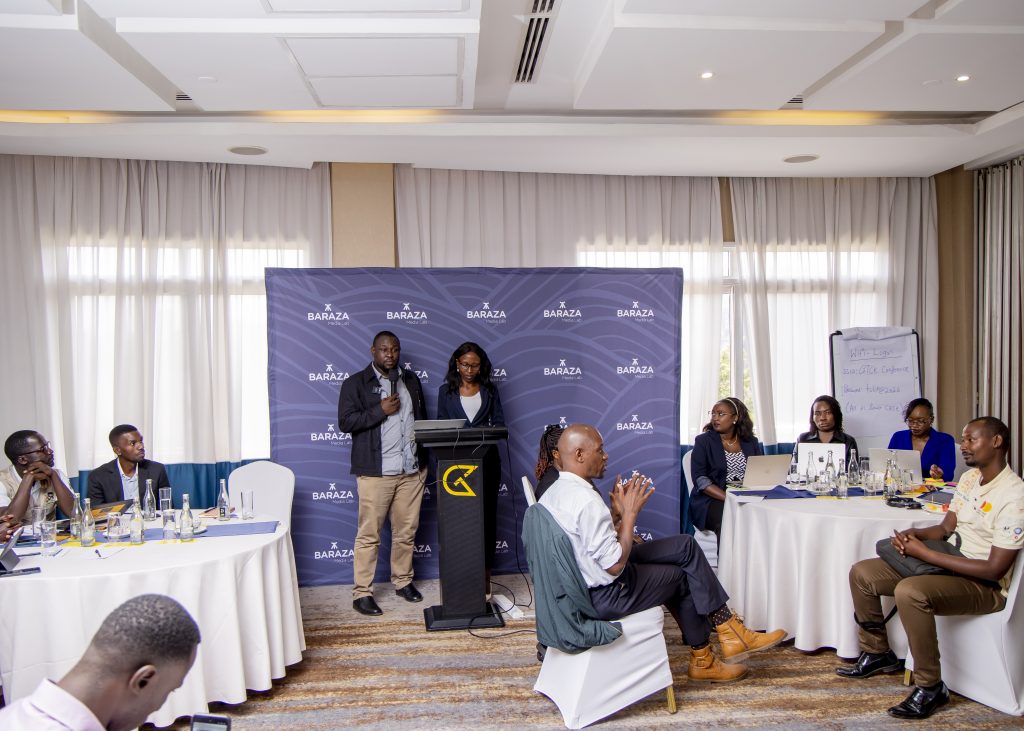
Convened by Baraza Media Lab in partnership with International Media Support under the Digital Democracy Initiative and supported by Uganda Editors’ Guild , the engagement brought together about 70 journalists, editors, researchers, students, civil society actors, climate advocates, government-linked stakeholders and community representatives.
Under the theme “Unheard or Misheard?”, participants examined why climate stories sometimes fail to reach, persuade or activate the communities and institutions for whom they are intended. The discussion moved beyond asking whether climate stories exist to interrogating whether they are accessible, trusted, locally relevant and connected to a clear pathway for action.
Information exists—but can people use it?
Across presentations, group work and plenary discussions, participants repeatedly distinguished between the availability of information and its usability. Research and climate data may exist in universities, institutional reports and global platforms, but often remain overly technical, poorly localised or inaccessible to journalists and communities.
The result is a communication-to-action gap. Accurate information may never reach the people who need it, while published stories may fail to identify who is responsible for responding or what audiences can do next. Participants argued that effective climate communication must therefore be understandable, relevant, persistent and directed towards actors with the authority or capacity to respond.
Climate stories were identified as particularly important for farmers, policymakers, persons with disabilities, young people, researchers and communities on the front lines of climate impacts. When told effectively, such stories can support disaster preparedness, adaptation, livelihood planning, public budgeting, accountability and informed community decision-making.
Communities must be narrators—not merely subjects
A major concern was the exclusion of indigenous and frontline communities from climate narratives and decision-making spaces. Participants observed that communities are frequently spoken about but are not given sufficient opportunity to tell, interpret or verify their own stories.
Contributions from grassroots climate actors highlighted how women, children, indigenous peoples and economically marginalised communities experience climate risks while also holding valuable place-based knowledge about changing seasons, floods, land, ecosystems and adaptation. The convening called for a shift away from portraying such communities only as victims and towards recognising them as knowledge holders, witnesses and contributors to solutions.
Participants also emphasised ethical reciprocity. Communities are often repeatedly interviewed without receiving the resulting stories, research findings or feedback on what happened next. More responsible storytelling should include culturally appropriate engagement, informed participation, realistic expectations and opportunities for communities to correct or contextualise narratives about their lives.
Language, accessibility and format shape who is heard
Language and accessibility emerged as decisive factors in whether climate information travels. English-only content, technical terminology, weak translation, inaccessible websites and poorly captioned multimedia can exclude large sections of the intended audience even when the underlying information is accurate.
Participants recommended local-language communication, accurate captions, audio and read-aloud formats, sign-language interpretation where appropriate, and screen-reader-compatible digital platforms. They also encouraged journalists and communicators to use documentaries, podcasts, mobile-phone storytelling, music, poetry and other creative formats that meet audiences where they already consume information.
The discussion underscored that accessibility is not an optional addition to climate communication. It determines whose knowledge enters public debate, who can prepare for climate risks and who can participate in decisions about adaptation and response.
Why media capacity and editorial leadership matter
The Uganda Editors’ Guild used the convening to highlight the responsibility of editors and newsroom leaders in sustaining credible, public-interest climate reporting. Political news, commercial pressures, limited newsroom resources and editorial gatekeeping can push climate stories to the margins or restrict coverage to moments of disaster.
UEG shared its experience of strengthening climate-reporting capacity through initiatives including a short course developed with Makerere University’s Centre for Climate Change Research and Innovation, as well as reporting grants that enabled journalists to use public-opinion data in producing climate stories. These interventions reflect the Guild’s broader commitment to equipping media professionals with the knowledge and editorial support required to report climate issues accurately and consistently.
The convening reinforced the need to train both reporters and editors in climate science, data interpretation, investigative methods, ethics and risk communication. Participants also proposed newsroom champions, commissioning opportunities, awards and other incentives that encourage sustained coverage rather than one-off reporting.
UEG’s contribution: connecting actors and strengthening the information chain
UEG’s contribution to the Kampala convening extended beyond participating in the discussion. Through stakeholder mapping and mobilisation, the Guild helped identify and connect media practitioners, students, researchers, civil society organisations, government actors and climate advocates whose perspectives are necessary for a stronger climate-information system.
This convening role reflects an important part of UEG’s mandate: creating trusted spaces where editors and other public-interest actors can examine difficult information challenges, strengthen professional practice and develop shared responses. Bringing these groups together allowed participants to identify where climate stories are distorted or stopped—from community access and translation to editorial decisions, political pressure, funding interests and weak institutional response.
The immediate contribution was a richer, cross-sector diagnosis of Uganda’s climate communication challenges. The longer-term opportunity lies in transforming the relationships and recommendations generated into stronger reporting partnerships, shared sources of credible data, more inclusive storytelling standards and sustained accountability.
From diagnosis to action
At the close of the convening, most working groups concluded that climate stories are being “misheard”; one described them as “unheard”, while another found that they are both unheard and misheard. The verdict reflected a common concern: producing more stories will not be enough if those stories remain inaccessible, lose community meaning, fail to reach the right audiences or generate no institutional response.
Participants proposed practical actions, including co-designing stories with frontline communities; translating research into newsroom-ready briefs and community materials; improving local-language and accessible formats; identifying duty-bearers and clear calls to action; strengthening institutional media-response channels; and creating a cross-sector network linking communities, media, researchers, government, civil society, funders and the private sector.
Baraza Media Lab announced that the Kampala meeting would be followed by country convenings in Kenya and Tanzania and subsequently a regional engagement. The process is expected to move from diagnosis towards practical solutions and regional learning.
For the Uganda Editors’ Guild, the conversation affirmed that climate communication is not only an environmental reporting issue. It is also a question of inclusion, public accountability, access to information and climate justice. When communities can participate in telling their own stories, journalists can access and interpret credible evidence, and institutions are clearly called upon to respond, climate communication is better positioned to contribute to meaningful action.