IDUAI2026: Can Access to Information Help the Media Address Information Disorder?
On 28 September, the world will mark the International Day for Universal Access to Information (IDUAI), a day dedicated to recognising the public’s right to seek, receive and use information and to highlighting the importance of transparent and accessible information systems.
This year’s global commemoration runs under the Theme: “Upholding Information Integrity in the Digital Age: The role of access to Information in addressing Information Disorder”.
The Government of the Republic of Sierra Leone, in collaboration with the United Nations Educational, Scientific and Cultural Organization (UNESCO), will host the global conference.
Nationally, The Uganda Editors’ Guild (UEG) will join the global commemoration with an X Space examining the role of Access to Information in addressing information disorder in Uganda.
Background
The right to seek, receive and impart information is recognized within the broader right to freedom of expression under Article 19 of the Universal Declaration of Human Rights. UNESCO’s General Conference subsequently proclaimed 28 September as the International Day for Universal Access to Information in 2015, following the adoption of Resolution 38 C/70. The United Nations General Assembly recognised the day at the UN level in October 2019.
The first global observance took place in 2016, with UNESCO describing access to information as important to human rights and dignity, sustainable development and the creation of inclusive knowledge societies. Since then, 28 September has become an important date for governments, information commissions, media organisations, civil society, academia and other stakeholders to reflect on the state of access to information around the world.
The day is also closely connected to the Sustainable Development Goals, particularly SDG 16.10, which calls for public access to information and the protection of fundamental freedoms.
IDUAI 2026
In 2026, the global IDUAI commemoration will take place in Freetown, Sierra Leone, from 28–30 September.
The Government of Sierra Leone, through its Right to Access Information Commission, is jointly hosting the global conference with UNESCO. The event will be held alongside the 17th International Conference of Information Commissioners (ICIC) at the Julius Maada Bio International Conference Centre.
The 2026 theme is:
“Upholding Information Integrity in the Digital Age: The Role of Access to Information in Addressing Information Disorder.”
The choice of theme places access to information directly within one of the defining challenges facing today’s information ecosystem: how societies can protect the integrity of information when misinformation, disinformation and manipulated content can spread rapidly.
The Freetown conference will bring together information commissioners, policymakers, civil society organisations, academics, journalists and other stakeholders to examine how timely and credible official information can contribute to information integrity and help address information disorder.
One of the central ideas behind the conference is that when public authorities do not proactively disclose information, or when citizens cannot obtain information through established channels, people may turn to less reliable sources to fill the information gap.
For journalism, this presents an important question: What happens when journalists are expected to provide accurate information to the public but cannot readily access the information needed to verify it?
Uganda’s right to information and the newsroom
Uganda is not new to this conversation.
The country’s Access to Information Act, 2005, gives effect to Article 41 of the Constitution, which provides citizens with a right of access to information held by the State, subject to specified limitations relating, among other things, to national security, sovereignty and privacy.
The Act’s stated objectives include promoting transparent and accountable government, ensuring public access to timely, accessible and accurate information, and enabling the public to scrutinise and participate in government decisions.
For journalists, these provisions have practical implications.
Access to official records, data, documents and responses from public institutions can help newsrooms move beyond claims and counterclaims to evidence-based reporting. It can also support investigative journalism, fact-checking and public-interest reporting.
But having a legal right to information and being able to effectively exercise that right are not necessarily the same thing.
This is where the newsroom conversation becomes important.
UEG brings the conversation to Uganda
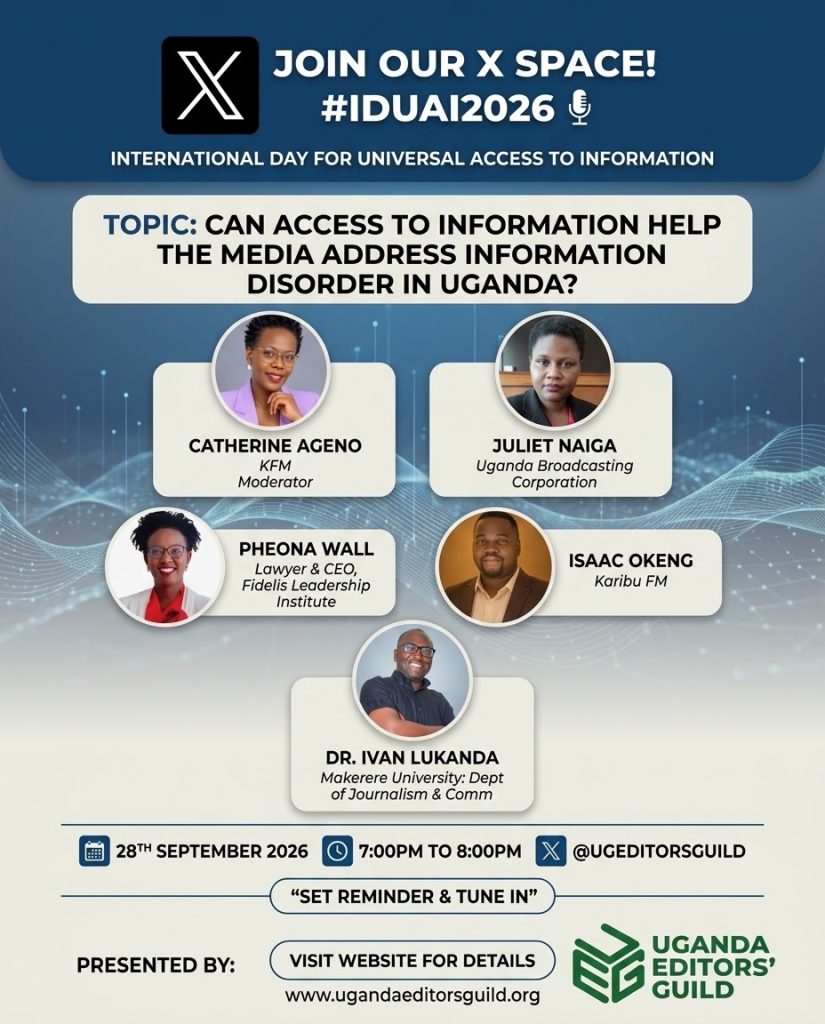
As part of the 2026 IDUAI commemoration, the Uganda Editors’ Guild will host an X Space on Monday, 28 September 2026, from 7:00 PM to 8:00 PM under the topic:
“Can Access to Information Help the Media Address Information Disorder in Uganda?”
The conversation is intended to bring the global IDUAI theme into the Ugandan media context and examine what Access to Information means in the everyday work of journalists and editors.
For UEG, the discussion is particularly relevant to its broader mandate of promoting media independence, professional journalism, public-interest reporting and access to information.
The Guild identifies advocacy for unfettered access to information for Ugandans and engagement on policy and legislative issues affecting the media among its areas of work.
The X Space will explore questions such as: Can better access to official information help journalists verify claims? What challenges do journalists face when seeking information from public institutions? How can newsrooms make better use of existing access-to-information mechanisms? And can stronger access to credible information contribute to addressing information disorder?
Who will be part of the conversation?
The discussion will bring together perspectives from journalism, broadcasting, law and academia.
Catherine Ageno, a journalist at KFM, will moderate the conversation.
She will be joined by Juliet Naiga of the Uganda Broadcasting Corporation (UBC), bringing a broadcasting perspective to the discussion; Pheona Wall, lawyer and CEO of Fidelis Leadership Institute, bringing a legal and governance perspective; Isaac Okeng of Karibu FM, representing the experience of radio journalism; and Dr Ivan Lukanda from the Department of Journalism and Communication at Makerere University, bringing an academic and media research perspective.
The conversation begins on X on 28 September at 7:00 PM.
Follow @UgEditorsGuild, set a reminder and join the conversation through this link: https://x.com/i/spaces/1DxLdZaBaRPxm?s=20
#IDUAI2026 #AccessToInformation #RightToKnow #InformationIntegrity #UgandaEditorsGuild